Tamil Nadu in the 1880s
23 events, 1881 to 1889; 1 marked as turning points.
1881
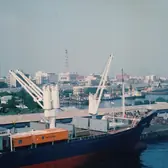
Madras Harbour begins operations
An artificial harbour at Madras began handling ships in 1881, though a cyclone the same year wrecked much of the breakwater.
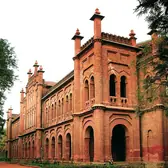
American College established in Madurai
American missionaries raised their Madurai mission school to a collegiate department in 1881, creating the American College.
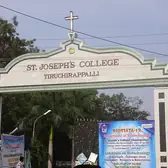
St. Joseph's College moves from Nagapattinam to Tiruchirappalli
St. Joseph's College, a Jesuit institution established at Nagapattinam in 1844, relocated to Tiruchirappalli.
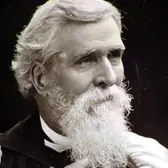
Caldwell's History of Tinnevelly published
The Madras government published Bishop Robert Caldwell's history of Tirunelveli district, drawn from manuscripts, Sangam texts and his own digs.
1882
Swadesamitran Tamil newspaper launched
G. Subramania Iyer started Swadesamitran, the first Tamil newspaper owned and run by Indians, in Madras.
Theosophical Society moves headquarters to Adyar
Helena Blavatsky and Henry Steel Olcott moved the headquarters of the Theosophical Society to Adyar in Madras.
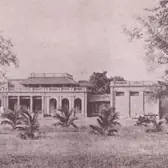
Hindu-Muslim riots broke out in Salem over a procession route past a new mosque; the trials that followed made C. Vijayaraghavachariar famous.
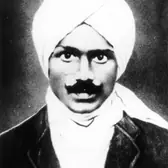
Birth of poet Subramania Bharati
Subramania Bharati, a pioneer of modern Tamil poetry and a nationalist journalist, was born at Ettayapuram.
1883
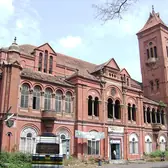
Victoria Public Hall built in Madras
The foundation stone of Victoria Public Hall, the town hall of Madras, was laid in 1883; it was named after Queen Victoria in 1888.
1884
The Madras Mahajana Sabha, an early political association of educated Indians in the Madras Presidency, was formed in 1884.
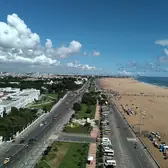
Governor Grant Duff creates the Marina promenade
Governor Mountstuart Elphinstone Grant Duff laid out a promenade along the Madras beach in 1884 and named it the Marina.
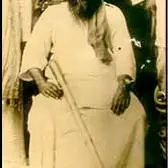
Subramania Siva, independence activist, writer and associate of V. O. Chidambaram Pillai, was born at Batlagundu.
1885
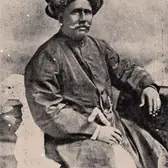
C. W. Damodaram Pillai publishes Tolkappiyam commentary
C. W. Damodaram Pillai published the Porulatikaram of the Tolkappiyam with Nachinarkiniyar's commentary, part of his revival of ancient Tamil texts.
Madras delegates at the first Indian National Congress
Of the 72 delegates at the first session of the Indian National Congress in Bombay, 22 came from the Madras Presidency.
1886
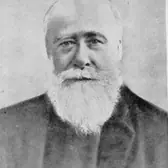
G. U. Pope publishes his English Tirukkural
Missionary scholar G. U. Pope published 'The Sacred Kurral', an English translation of the Tirukkural with grammar, notes and lexicon.
Iyothee Thass declares Dalits are not Hindus
Anti-caste activist Iyothee Thass declared that the depressed classes were not Hindus, a stand he later carried into the Dravida Mahajana Sabha and the 1891 census.
Periyar lease agreement with Travancore
A 999-year lease for the Periyar irrigation works, signed by Travancore and the Secretary of State for India, later underpinned the Mullaperiyar dispute.
1887
U. V. Swaminatha Iyer publishes Jeevaka Chintamani
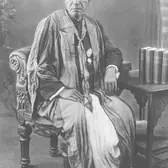
U. V. Swaminatha Iyer published Jeevaka Chintamani, the first of his editions of classical Tamil works recovered from palm-leaf manuscripts.
Indian National Congress holds first Madras session
The third session of the Indian National Congress met in Madras under the presidency of Badruddin Tyabji.

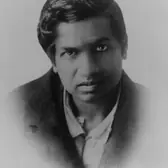
Birth of mathematician Srinivasa Ramanujan
Erode was the birthplace of Srinivasa Ramanujan, the self-taught mathematician famed for his work in number theory and infinite series.
1888
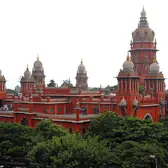
Construction of the Madras High Court building begins
Construction started in George Town, Madras, on the Indo-Saracenic High Court complex, designed by J. W. Brassington and opened in 1892.
1889
The Hindu becomes a daily newspaper
The Hindu, founded as a weekly in 1878 by the 'Triplicane Six', began publishing daily in 1889.
Victoria Technical Institute opens in Madras
Marking Queen Victoria's golden jubilee, the Victoria Technical Institute opened on Pantheon Road in Egmore.